First: Ahwaz Historically
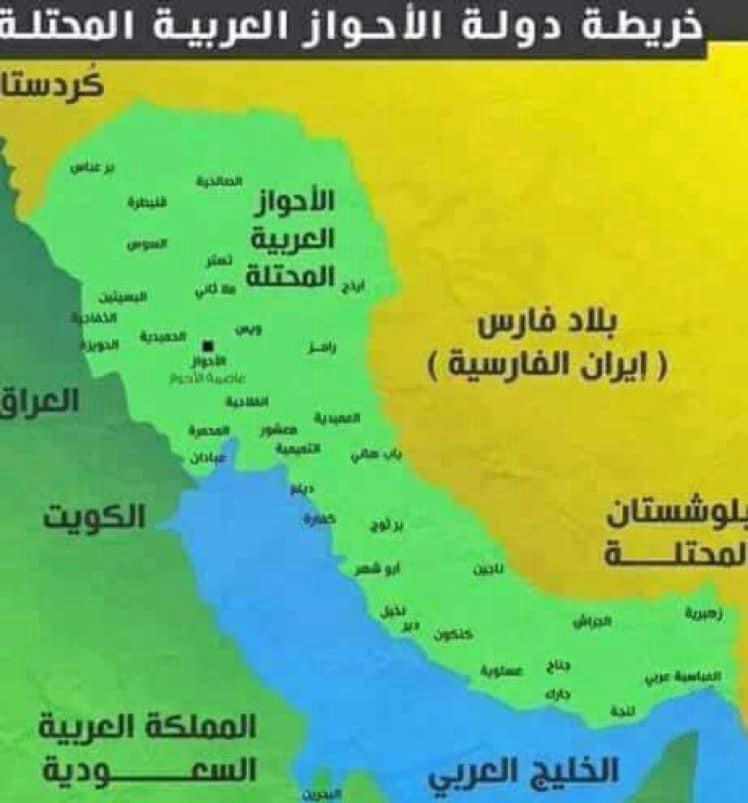
Ahwaz (also known as Khuzestan, Bushehrin, parts of Hormozgan, parts of Ilam, and Kohgiluyeh and Boyer-Ahmad in Persian sources) is an Arab region located on the eastern bank of the Arabian Gulf up to the Strait of Hormuz. Historically, Ahwaz was an independent Arab state ruled by various Arab dynasties, such as the Mushasha dynasty (1436–1724) and the Al-Kaabi dynasty until 1925.
• 1925: Iranian forces led by Reza Shah Pahlavi occupied Ahwaz after capturing its last ruler, Sheikh Khazal Al-Kaabi, on April 20, 1925. This date marks the beginning of the Iranian occupation and a continuous period of oppression against the Ahwazi people.
• Population: Although there is no official population census, estimates suggest that the population of Ahwaz ranges between 12 and 14 million people.
Second: Ahwaz Geographically
Ahwaz is located in the southwestern part of present-day Iran, bordered by:
• West: Iraq
• South: The Arabian Gulf up to the Strait of Hormuz
Main Geographical Features
• Strategic Location: Overlooks the Arabian Gulf and the Strait of Hormuz, making it geopolitically and economically significant.
• Rich Natural Resources: Ahwaz is one of the wealthiest regions in oil and gas, hosts the Bushehr nuclear power plant, and contains all the major ports from Abadan on the Shatt al-Arab to the ports along the Arabian Gulf up to the Strait of Hormuz.
• Fertile Land: With important rivers such as the Karun, Karkheh, and Jarrahi, it is one of the most fertile agricultural regions.
• Diverse Climate: A blend of coastal desert climate and fertile mountainous areas in the northeast.
• Major Cities: Ahwaz (capital), Muhammarah, Abadan, Hawizeh, Susa, Al-Falahiya, Bandar-e Mahshahr, Dorq, Al-Qunaitra, Masjed Soleiman, Al-Salihiya, Al-Khafajiya, Bushehrin, Lengeh City, and Bandar Abbas.
Third: Political Situation
Since its occupation, Ahwaz has suffered from political marginalization and denial of basic rights. Despite continuous peaceful demands by the Ahwazi people for self-determination, the Iranian regime maintains repressive and systematically racist policies aimed at erasing the Arab identity and tightening control over the region.
• Lack of Political Representation: Ahwazis are deprived of genuine representation in Iranian political institutions. Even those who achieve positions in these institutions do so by participating in the suppression of Ahwazis to prove their loyalty to the occupying authorities.
• Discriminatory Laws: The regime enforces discriminatory laws that prevent Ahwazis from accessing high-level jobs and limit their political and social participation.
Fourth: Economic and Social Situation
Despite its vast natural wealth, Ahwaz faces economic discrimination, resulting in high poverty and unemployment rates compared to other Iranian regions.
• Unemployment and Deprivation: The government imposes restrictions on employing Ahwazis in key sectors such as oil and gas, giving priority to Persian settlers as part of a demographic change policy.
• Lack of Basic Services: Ahwazis suffer from severe shortages in healthcare, education, and infrastructure.
• Resource Exploitation: Ahwaz’s natural resources are exploited to serve the Iranian economy, while the local population is deprived of their benefits.
Fifth: Cultural and Educational Situation
The Iranian authorities pursue policies to erase Ahwazi cultural identity by:
• Banning Arabic Education: Schools operate exclusively in Persian, with Arabic language instruction prohibited, leading to generations of Ahwazis being disconnected from their mother tongue.
• Restricting Cultural Activities: Authorities ban Arab-themed festivals and celebrations and impose severe restrictions on Ahwazi cultural and artistic activities.
• Censoring Arabic Media: Establishing Arabic-language media outlets is forbidden, and newspapers and magazines in Arabic are censored.
Sixth: Major Violations since 1925
Iranian authorities have committed numerous severe violations against the Ahwazi people, including:
1. Mass Executions: Thousands of Ahwazis have been arrested and executed on false charges such as demanding national rights.
2. Demographic Change: Forced displacement of Ahwazis and their replacement with Persian settlers to alter the population composition.
3. Cultural Erasure: Banning the use of Arabic in education and media and prohibiting Arab cultural celebrations.
4. Economic and Social Discrimination: Despite Ahwaz’s vast natural wealth, its people suffer from extreme poverty, unemployment, and denial of basic services.
5. Military Repression: Imposing strict security policies and deploying heavy military presence across Ahwaz.
6. Environmental Destruction: Diverting Ahwazi rivers like Karun to Persian regions has caused farmland to dry up, depriving locals of their livelihoods. Additionally, unregulated oil extraction has resulted in widespread environmental pollution.
7. Targeting Activists: Political activists opposing the Iranian regime’s policies are systematically assassinated, arrested, or tortured to extract false confessions. They are later executed publicly or secretly, either individually or in mass executions. Iran prohibits any form of Arab political activity or the formation of political parties or organizations that express legitimate demands, violating international laws and human rights, starting with the Universal Declaration of Human Rights.
Adpf.org